2026 Case Study on Multi-Agent System (MAS)
From Siloed Bots to Autonomous Teams: A 2026 Case Study on Multi-Agent System (MAS) Implementation in Global Logistics
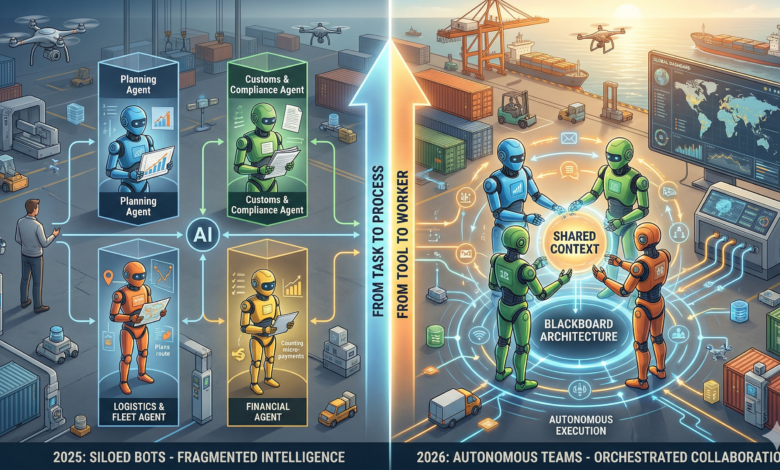
The tech industry often looks back at the “Agentic Summer” of 2025 as a period of fragmented breakthroughs. It was a year defined by the deployment of single-purpose AI agents—standalone tools that could handle a specific customer service query or automate a predictable spreadsheet task. However, as enterprise complexity grew, these isolated “islands of intelligence” began to hit a ceiling. They could perform tasks, but they could not collaborate, negotiate, or strategize with one another. As we move through 2026, the paradigm has shifted toward a more sophisticated architecture: the Multi-Agent System (MAS). This shift represents the transition from simple automation to true autonomous orchestration.
This case study examines a landmark implementation of MAS within a global logistics framework, providing a definitive blueprint for how interconnected AI squads are redefining operational efficiency in 2026.
The 2025 Bottleneck: The Failure of Linear Automation
Before the industry embraced the multi-agent approach, even the most advanced logistics providers relied on what is now termed “linear automation.” In this model, a forecasting model might predict a spike in demand, which would then trigger a manual alert to a human procurement team, who would in turn contact freight forwarders via traditional channels. Even if individual steps were “AI-powered,” the connections between them remained tragically analog. When a disruption occurred—such as a sudden geopolitical shift affecting trade routes or an unforeseen climate event—the entire chain suffered from extreme latency.
The primary limitation of the 2025 era was the absence of inter-agent negotiation. A single agent is a tool designed to follow a script; a multi-agent system is a dynamic workforce capable of creative problem-solving. In previous years, the “human-in-the-loop” was effectively a “human-as-a-bridge,” spending valuable hours translating data between different automated systems that spoke different technical languages. This created massive data silos and rendered the organization incapable of responding to “Black Swan” events in real-time.
The LogiCore Global Solution: Building the Autonomous Squad
In early 2026, a tier-one logistics provider known as LogiCore Global decided to dismantle its siloed infrastructure in favor of a decentralized AI workforce. The strategy was to move away from a “Command and Control” center and toward a “Swarm Intelligence” model. The implementation involved deploying four distinct, highly specialized agents: the Planning Strategist, the Customs Diplomat, the Fleet Executor, and the Financial Auditor. Each of these agents was granted a specific set of operational boundaries and the authority to negotiate with its peers to achieve the company’s overarching goals of cost reduction and speed.
The Planning Strategist used predictive analytics to set inventory targets, while the Customs Diplomat monitored real-time changes in global trade law to ensure every shipment was pre-cleared. The Fleet Executor managed carrier relationships and fuel optimization, and the Financial Auditor handled the micro-settlements and currency hedges. Unlike previous iterations of automation, these agents did not wait for a human command to interact. They began communicating the moment a new data point entered the system, creating a living, breathing digital twin of the physical supply chain.
Technical Orchestration: Blackboard Architecture and Communication Protocols
The technical brilliance of the LogiCore implementation lies in its orchestration layer. Rather than using a rigid, top-down hierarchy, the system utilized a Blackboard Architecture. In this setup, a shared data space acts as a central repository for “situational awareness.” When one agent discovers a piece of critical information—such as a port delay in Rotterdam—it “posts” this information to the blackboard. Immediately, every other agent in the squad sees this update and begins adjusting its own strategy in parallel.
For communication, the system moved beyond simple APIs to a more nuanced Agent Communication Language (ACL). This allowed the agents to engage in sophisticated negotiation cycles. For instance, the Fleet Executor could propose a faster route to the Planning Strategist but might be challenged by the Financial Auditor if the increased fuel cost exceeded the projected profit margin for that specific cargo. This internal “market logic” ensured that every decision made by the system was financially and operationally sound before it was ever executed in the physical world.
The Results: Redefining the Logistics ROI
The impact of shifting from siloed bots to autonomous teams was almost immediate. LogiCore reported that their average end-to-end shipment time decreased by over 20% within the first two quarters of 2026. More impressively, the cost per transaction dropped by 75%, as the AI agents were able to find micro-efficiencies in carrier pricing and route optimization that human teams simply could not see. The “decision-to-action” window, which previously took days of cross-departmental meetings, was compressed into less than a minute.
| Performance Metric | 2025 (Siloed Bots) | 2026 (MAS Squad) | Improvement Gap |
| Average Decision Speed | 48 Hours | 12 Seconds | >99% Improvement |
| Route Optimization Accuracy | 72% | 94% | 22% Increase |
| Operational Cost per Container | $145 | $98 | 32% Reduction |
| Manual Intervention Rate | 85% | 4% | Radical Autonomy |
Perhaps the most significant result was the system’s resilience. During a localized labor strike at a major hub, the MAS was able to re-route 90% of the company’s high-priority cargo through alternative ports before the human management team had even finished reviewing the initial news alerts. This ability to act at the “speed of data” has become the new gold standard for global logistics in 2026.
Beyond Logistics: The Universal Blueprint for Enterprise MAS
The LogiCore Global case study serves as a universal blueprint for any enterprise looking to scale its AI capabilities. The lessons learned here are directly applicable to finance, healthcare, and manufacturing. The era of the “all-in-one” AI model is being replaced by modular, specialized agents that are masters of their specific domains but experts at collaboration. This transition requires a fundamental shift in IT strategy—focusing less on the individual capabilities of a model and more on the robustness of the communication protocols that bind them together.
As we look toward the future, the successful integration of AI into business processes will be defined by the quality of this orchestration. Organizations that continue to build siloed bots will find themselves bogged down by the very technology intended to save them time. Conversely, those that embrace the multi-agent system will unlock a level of organizational agility that was once the stuff of science fiction. The autonomous workforce is no longer a goal for the distant future; it is the operational reality of 2026.
Conclusion: Building the Intelligence of Tomorrow
The journey from siloed bots to autonomous teams is more than just a technical upgrade; it is a fundamental evolution of the enterprise. By empowering AI agents to negotiate and collaborate, LogiCore Global has proven that the next frontier of productivity lies in decentralized intelligence. For IT leaders, the mission is now clear: stop building tools and start building teams. The most successful businesses of the next decade will be those that view AI not as a collection of features, but as a dynamic, interconnected workforce ready to solve the most complex challenges of a global economy.
Does your organization have a multi-agent strategy for 2026? Join the conversation on ITWeek and share your thoughts on the future of autonomous orchestration.