The AI Coding Dilemma: Performance vs. Autonomy
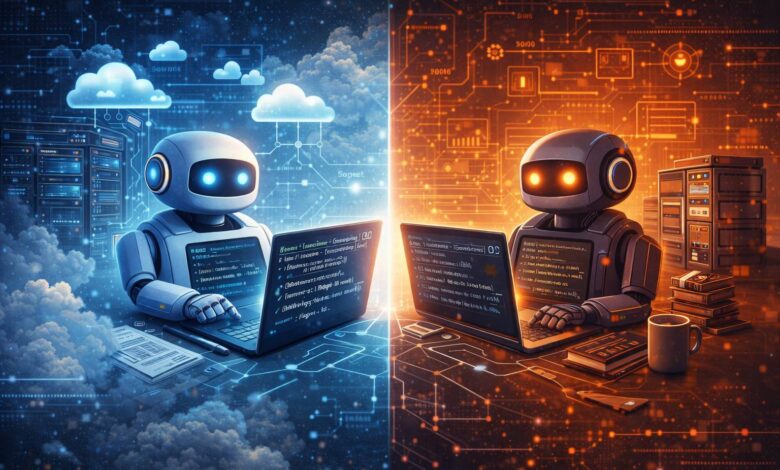
The software development landscape is currently divided by two philosophies of AI assistance: the SaaS model (exemplified by Anthropic’s Claude Code) and the Local/Open-Source model (led by Block’s Goose). While both aim to provide “agentic” coding—meaning they don’t just suggest lines of code but can actually execute terminal commands, run tests, and manage files—their architectures and costs couldn’t be further apart.
1. Claude Code: The Power of the Cloud
Claude Code is a “thin client” that connects your local terminal to Anthropic’s massive server farms. This allows it to leverage Claude 4.5 Opus, currently one of the most sophisticated reasoning models in existence.
-
The Advantage: High “reasoning” capabilities and a massive 1-million-token context window, allowing the AI to “read” an entire large-scale codebase at once.
-
The Friction: High costs ($20–$200/month) and controversial “usage hours” that translate to token-based limits. If you hit your limit, your productivity effectively halts until the next reset.
2. Goose: The Local Revolution
Goose, developed by Block, is a model-agnostic agent. It provides the “scaffolding” (the ability to edit files and run shells) but lets you choose the “brain” (the LLM).
-
The Advantage: By using Ollama to run models like Qwen 2.5 or Llama 3 locally, you gain total privacy, offline access, and zero subscription fees.
-
The Friction: Performance is limited by your computer’s hardware. You need significant RAM (ideally 32GB+) to run models that can compete with Claude’s reasoning.
Comparison: At a Glance
| Feature | Claude Code | Goose (Local Setup) |
| Monthly Cost | $20 – $200 | $0 |
| Data Privacy | Code sent to Anthropic | Stays on your machine |
| Internet | Required | Not required (Offline) |
| Model | Claude 4.5 (Proprietary) | Any (Ollama, OpenAI, etc.) |
| Limits | Tokens/Hours per week | Unlimited |
| Setup | Plug-and-play | Technical (Requires Ollama) |
Why “Tool Calling” Matters
Both tools rely on a concept called Tool Calling (or Function Calling). This is the mechanism that allows an AI to realize, “I don’t just need to talk about code; I need to run ‘npm test’ to see if I fixed the bug.”
When you use Goose with a local model, the model must be “fine-tuned” for tool calling. If the model isn’t smart enough, it might hallucinate commands or fail to follow the correct syntax to interact with your computer’s file system.
The Shift Toward Sovereignty
The rise of Goose signals a growing “developer sovereignty” movement. As open-source models like DeepSeek and Qwen close the gap with proprietary giants like Claude and GPT, the justification for high monthly subscriptions weakens.
For professional developers, the choice often comes down to Context vs. Cost. If you are working on a massive, interconnected enterprise codebase, Claude’s 1-million-token window is nearly indispensable. However, for feature development, debugging, and building new modules, a local setup with Goose offers a level of freedom and privacy that cloud providers simply cannot match. We are entering an era where the most powerful dev tool isn’t just the one with the best AI, but the one that doesn’t stop working when you lose your Wi-Fi or exceed a “token hour.”