Apple and Major Tech Rivals Receive Poor Grades in 2026 PIRG Repairability Report
A new study by the Public Interest Research Group (PIRG) Education Fund has revealed that despite marginal improvements in design, the world's leading technology manufacturers are still struggling to meet repairability standards for laptops and smartphones.

The report, titled “Failing the Fix (2026),” analyzed the latest devices available as of January 2026. Leveraging criteria from the French repairability index and the European Product Registry for Energy Labelling (EPREL), PIRG evaluated the ten newest products from major vendors. The findings highlight a persistent gap between corporate sustainability claims and the physical reality of device maintenance.
Apple and Lenovo Trail in Laptop Rankings
Apple earned the lowest marks among laptop manufacturers, receiving a C-minus. The grade was largely driven by poor “disassembly scores,” a metric PIRG weighted heavily to reflect consumer expectations regarding physical access to hardware.
Lenovo followed closely with its own C-minus, though for different reasons. While the company showed slight improvement over its 2025 “F” grade, it continues to face criticism for failing to provide required repairability documentation (PDFs) on its French website—a multi-year compliance issue the company previously attributed to technical “backend” errors.
Both Apple and Lenovo, along with Samsung and Dell, also saw their scores docked for their membership in trade organizations like TechNet and the Consumer Technology Association (CTA). These groups have historically lobbied against Right to Repair legislation in the United States.
Smartphones: The Update Trap and Parts Pairing
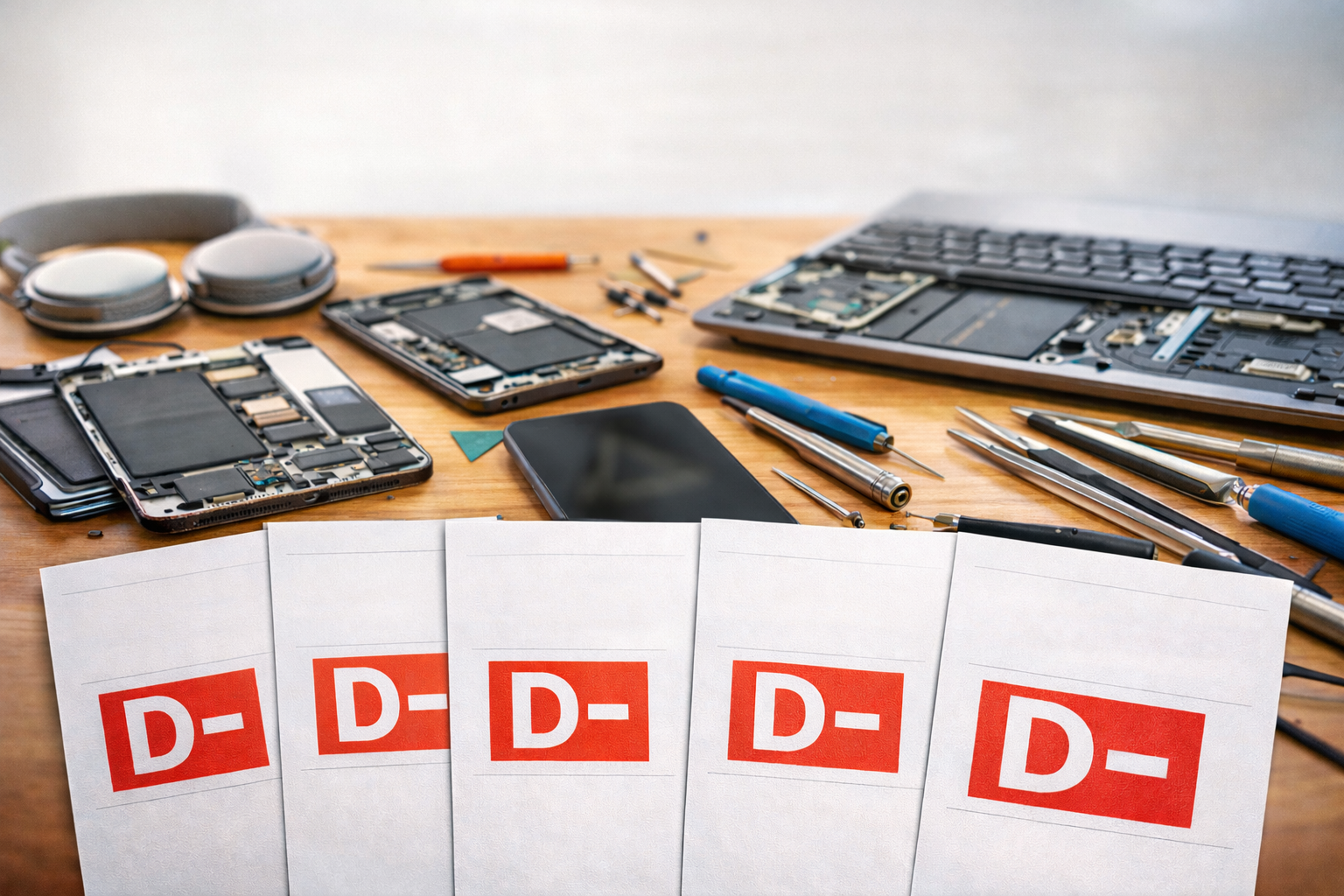
The smartphone sector saw even lower performance. Apple received a D-minus, hampered by the EPREL scoring system which penalizes manufacturers that guarantee software updates for only five years.
While PIRG acknowledged Apple’s progress in moving away from “parts pairing”—the practice of using encrypted software checks to verify components—new barriers have emerged. The report highlighted the extension of “Activation Lock” to individual components, a move intended to deter theft but one that advocates warn could “lock out” functional parts from the secondary repair market. Furthermore, third-party Face ID replacements remain non-functional, limiting independent repair options.
Pockets of Progress
Despite the overall low grades, the report noted specific instances of better design. Nathan Proctor, senior director of US PIRG’s Right to Repair campaign, specifically cited the MacBook Neo as a “step in the right direction.”
Industry-wide, while physical disassembly remains a hurdle due to long manufacturing cycles, Proctor noted that consumer access to official parts, tools, and technical manuals has significantly improved compared to previous years.
Editor’s Analysis: The Friction Between Security and Sustainability
The 2026 PIRG report underscores a deepening tension in the tech industry: the conflict between device security and circular economy goals.
From a technical standpoint, Apple’s decision to link Activation Lock to individual hardware components is a sophisticated anti-theft measure, but it creates a “digital graveyard” for spare parts. This effectively turns hardware into a proprietary ecosystem that cannot be easily salvaged or reused by third parties.
Furthermore, the industry’s “stagnant” repairability scores suggest that while manufacturers are yielding to legislative pressure by providing more documentation, they are hesitant to overhaul the physical architecture of their devices. True “Information Gain” for the consumer will only occur when ease of disassembly matches the availability of the repair manual. Until modularity becomes a core design principle—rather than a secondary compliance check—we should expect repairability grades to hover in the C to D range for premium, thin-and-light consumer electronics.