Integrating AI into Business Processes
The dawn of 2026 has brought about a fundamental shift in how the global economy perceives artificial intelligence. We have moved past the era of experimental chatbots and viral image generators into a period of deep, structural integration. For the modern enterprise, the question is no longer whether to adopt AI, but how to weave it into the very fabric of daily operations without disrupting the core value proposition. This guide serves as a comprehensive roadmap for leaders who are ready to move beyond the hype and implement AI integration in business processes with a focus on long-term scalability and measurable efficiency.
The Philosophical Shift from Tool to Infrastructure
Before diving into the technical nuances of implementation, it is essential to understand that AI is not a standalone software update; it is a foundational layer of infrastructure. Much like the transition to electricity or the internet, AI changes the speed at which information moves and decisions are made. Successful integration begins with a mindset shift where AI is viewed as a collaborative partner rather than a replacement for human intuition. Organizations that thrive in this environment are those that identify specific friction points within their existing workflows and apply intelligence where it can remove bottlenecks, rather than applying it indiscriminately across the board.
The primary goal of any AI integration strategy should be the liberation of human talent. By automating high-volume, low-complexity tasks, companies allow their workforce to focus on high-value creative and strategic endeavors. This synergy creates a virtuous cycle of productivity that defines the competitive landscape of 2026. However, reaching this state requires a disciplined, step-by-step approach that prioritizes data integrity and cultural readiness over rapid, haphazard deployment.
Phase One: Strategic Alignment and Identifying High-Impact Use Cases
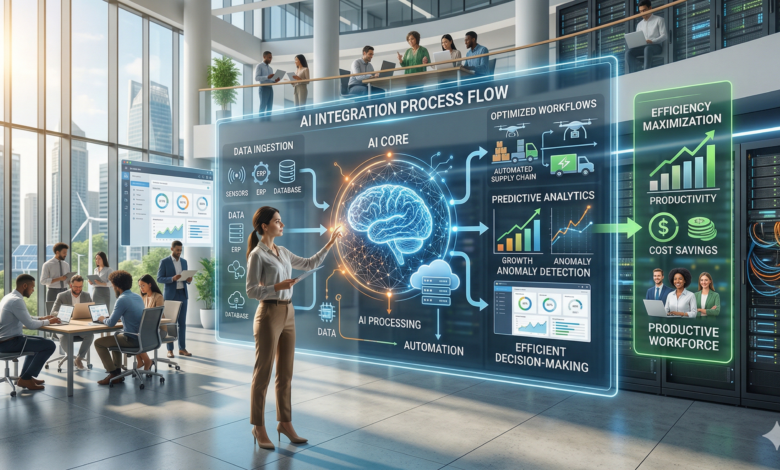
The most common mistake in AI integration is starting with the technology rather than the problem. A successful journey begins with a rigorous internal audit of business processes to identify where intelligence can provide the highest return on investment. Leaders must look for “the three Vs”: high volume, high velocity, and high variability. Processes that involve large amounts of data, require rapid turnaround, or demand constant adjustment based on shifting variables are the prime candidates for AI-driven optimization.
For instance, in supply chain management, AI can be integrated to predict disruptions by analyzing global news, weather patterns, and shipping data in real-time. In customer service, it can move beyond simple FAQ responses to sentiment analysis that routes complex emotional issues to specialized human agents while resolving routine queries instantly. By focusing on these high-impact areas first, organizations can demonstrate quick wins that build momentum and secure internal buy-in for larger, more complex transformations down the line.
Phase Two: Building the Data Foundation and Infrastructure
Artificial intelligence is only as effective as the data that fuels it. One cannot expect sophisticated insights from a fragmented or neglected data ecosystem. Therefore, the second phase of integration focuses on breaking down data silos and establishing a “single source of truth.” In the current landscape, this often involves moving toward a data lakehouse architecture—a hybrid model that combines the structured nature of a data warehouse with the immense flexibility of a data lake.
Data hygiene is perhaps the most labor-intensive part of the process, yet it is the most critical. This involves cleaning historical records, ensuring consistent formatting, and establishing real-time data pipelines. Furthermore, the concept of “data sovereignty” has become paramount in 2026. Businesses must ensure that their proprietary data remains secure and is not used to train public models that could inadvertently benefit competitors. Implementing robust encryption and private cloud environments is a non-negotiable step in preparing the infrastructure for enterprise-grade AI.
Phase Three: The Build vs. Buy Dilemma and Vendor Selection
Once the strategic goals are set and the data foundation is laid, organizations face a critical decision: should they build custom AI models or purchase existing solutions? In 2026, the answer is rarely binary. Most successful integrations utilize a “hybrid” approach. For standard administrative tasks—such as automated scheduling or basic content generation—off-the-shelf software-as-a-service (SaaS) products with built-in AI capabilities are often the most cost-effective choice.
However, for core business processes that provide a competitive advantage, custom-built or heavily fine-tuned models are essential. This is where Retrieval-Augmented Generation (RAG) and specialized Small Language Models (SLMs) come into play. By using RAG, a company can connect a powerful large language model to its internal knowledge base, allowing the AI to provide answers that are highly specific to the company’s unique history, legal requirements, and operational protocols. Selecting the right partners during this phase involves looking beyond technical specifications to evaluate the vendor’s commitment to security, transparency, and ethical AI practices.
Phase Four: Pilot Programs and the Iterative Prototyping Cycle
The transition from a theoretical plan to a live business environment should never happen overnight. Instead, the implementation should be channeled through a series of controlled pilot programs. A pilot program allows a specific department or team to test the AI integration in a real-world scenario without risking the entire organization’s stability. This “sandbox” approach is vital for identifying unforeseen technical glitches or cultural resistance.
During the pilot phase, the focus should be on iterative prototyping. This means deploying a “Minimum Viable Product” (MVP), gathering feedback from the actual users on the ground, and making rapid adjustments. It is during this stage that the importance of user experience (UX) becomes clear. If the AI tool is difficult to use or adds extra steps to a worker’s day, it will be rejected regardless of its theoretical efficiency. Integration must be seamless, ideally living within the tools and interfaces that employees already use daily, such as their email clients, project management software, or CRM dashboards.
Phase Five: Scaling and Managing the Human Element
Scaling AI across an entire enterprise is less of a technical challenge and more of a psychological one. The fear of displacement is a powerful deterrent to adoption. Therefore, a successful rollout requires a robust change management strategy that prioritizes transparency and education. Employees need to understand that the goal of AI integration in business processes is to augment their capabilities, not to render them obsolete.
Comprehensive training programs are essential. In 2026, “AI literacy” is a core competency for every employee, from the executive suite to the front line. This involves teaching staff how to interact with AI models, how to verify the accuracy of AI-generated outputs, and how to identify potential biases. Furthermore, the organization’s leadership must lead by example, openly using AI tools in their own workflows and sharing the results. When employees see AI as a powerful assistant that takes away the “drudgery” of their jobs, they become the biggest advocates for the technology.
Phase Six: Ethical Governance and Future-Proofing
As AI becomes deeply embedded in business processes, the need for ethical governance becomes unavoidable. This involves establishing an “AI Ethics Board” or a similar governing body to oversee the deployment of models. This board is responsible for ensuring that AI-driven decisions are transparent, explainable, and free from harmful bias. In many jurisdictions, this is no longer just a best practice but a legal requirement under evolving digital regulations.
Future-proofing the integration means building systems that are modular and adaptable. The AI landscape moves at a staggering pace; a model that is state-of-the-art today might be obsolete in eighteen months. By utilizing API-driven architectures and open standards, businesses can ensure that they can “swop out” older models for newer, more efficient ones without having to rebuild their entire infrastructure from scratch. This agility is the hallmark of a truly mature digital enterprise.
The Long Road to AI Maturity
Integrating AI into business processes is not a project with a defined end date; it is a journey toward a new state of being. The efficiencies gained through this process—whether in the form of reduced operational costs, faster time-to-market, or enhanced customer satisfaction—are cumulative. Over time, these small optimizations compound into a massive competitive advantage that defines industry leaders.
For those just beginning this journey, the key is to start with intention. Begin with the problem, respect the data, empower the people, and never stop iterating. The future of business belongs to those who can master the art of human-AI collaboration, turning complex technology into a silent, powerful engine of growth. By following this structured, step-by-step approach, your organization can move beyond the noise of the digital gold rush and build something that lasts: a smarter, more resilient, and infinitely more efficient business for the decades to come.