What Is Zero Trust Security? Architecture, Principles, and Real-World Use Cases

Cybersecurity used to rely heavily on a simple assumption: once a user or device was inside the network, it could often be trusted. That model no longer reflects how modern organizations operate. Today’s IT environments are distributed across cloud platforms, remote endpoints, SaaS applications, contractors, branch offices, and third-party integrations. In that reality, trust based on location alone is no longer sufficient.
Zero Trust is a security model built around a different assumption: no user, device, application, or workload should be trusted by default. Every access request must be verified continuously based on identity, context, device posture, policy, and risk.
This is why Zero Trust has become one of the most important cybersecurity strategies in enterprise IT, government systems, cloud infrastructure, and hybrid work environments. But despite the term’s popularity, Zero Trust is often misunderstood. It is not a single product, not a one-time deployment, and not just another name for identity management.
This guide explains what Zero Trust security actually means, how Zero Trust architecture works, which core principles define it, where organizations use it in practice, and why it matters more than ever in today’s threat landscape.
What is Zero Trust security?
Zero Trust security is a cybersecurity approach based on the principle of “never trust, always verify.” Instead of automatically trusting users or systems because they are inside a corporate network, Zero Trust requires continuous validation before granting or maintaining access.
In a Zero Trust model, access decisions are based on factors such as:
- user identity
- device health and compliance
- application context
- network location
- risk score
- least-privilege policy
- ongoing behavioral signals
The goal is to reduce the risk of unauthorized access, credential abuse, lateral movement, and overexposed systems.
In practical terms, Zero Trust changes the question from:
“Is this user inside the network?”
to:
“Should this specific user, on this device, under these conditions, have access to this exact resource right now?”
That shift is what makes Zero Trust fundamentally different from older perimeter-based security models.
Why Zero Trust matters now
Zero Trust is not just a trendy framework. It became essential because the assumptions behind traditional security have broken down.
Organizations now face several structural changes at once:
- more remote and hybrid work
- widespread SaaS adoption
- multi-cloud and hybrid-cloud environments
- unmanaged or partially managed devices
- growing use of third-party access
- identity-based attacks
- ransomware and lateral movement campaigns
- faster exploitation of exposed applications
When users, apps, and data are spread across many environments, the idea of a fixed corporate perimeter becomes less useful. Attackers know this. Instead of trying only to breach the network edge, they increasingly target identities, credentials, cloud misconfigurations, exposed applications, and privileged access paths.
Zero Trust addresses that problem by narrowing access, segmenting resources, continuously validating trust, and assuming compromise is always possible.
The core principle: never trust, always verify
The phrase most closely associated with Zero Trust is simple, but it carries deep operational implications.
Never trust means no person, device, service, or workload gets broad access by default.
Always verify means trust is not granted once and forgotten. It must be evaluated continuously.
This is different from older models where a successful login could lead to wide access across systems. In Zero Trust, authentication is not the end of the process. It is only one layer of a broader policy decision.
Verification can include:
- multi-factor authentication
- device compliance checks
- session risk scoring
- geolocation context
- time-based policies
- workload identity validation
- user behavior analytics
- continuous authorization
In mature Zero Trust environments, access is dynamic, contextual, and narrowly scoped.
What Zero Trust is not
Zero Trust is often oversimplified, which leads to bad planning and poor implementation. It helps to be clear about what it is not.
Zero Trust is not:
- a single vendor product
- only an identity and access management project
- only network segmentation
- a synonym for SASE
- a firewall replacement
- a quick fix that can be deployed overnight
- a guarantee that breaches will never happen
Instead, Zero Trust is a security strategy and architectural model that brings together identity, endpoint, network, application, data, and analytics controls under a least-privilege, continuously verified framework.
The main principles of Zero Trust architecture
While implementations vary, most strong Zero Trust programs are built around a common set of principles.
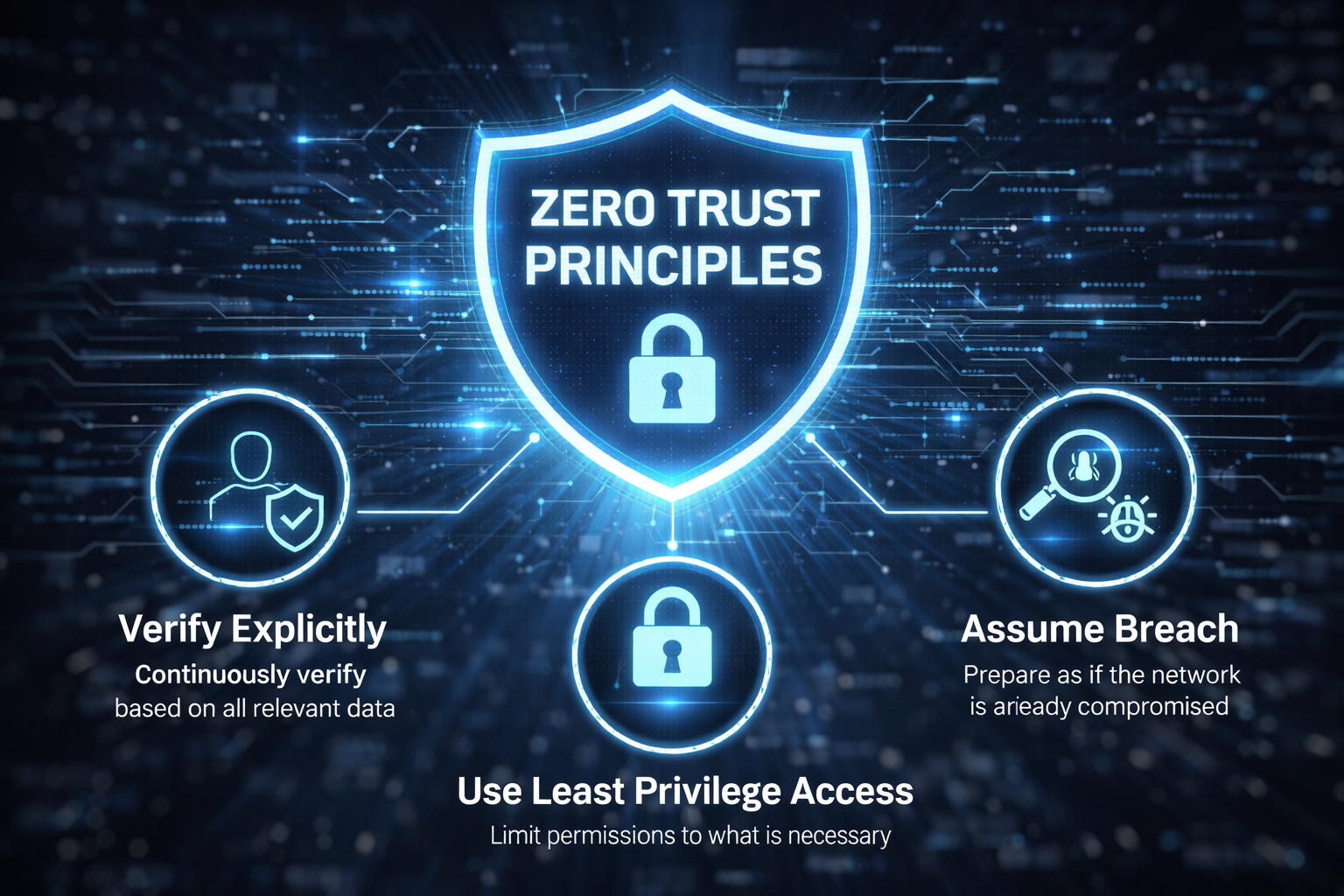
1. Verify explicitly
Every access request should be evaluated using as much relevant context as possible. That includes identity, device health, workload attributes, location, session context, and observed risk.
The idea is not just to authenticate users, but to make better access decisions based on real conditions.
2. Use least-privilege access
Users and systems should receive only the minimum level of access they need, for the minimum amount of time necessary.
This reduces the blast radius if credentials are stolen or a workload is compromised.
Least privilege can involve:
- role-based access control
- just-in-time access
- just-enough administration
- privileged access approvals
- scoped service permissions
3. Assume breach
Zero Trust assumes that compromise is possible or may already have occurred. This changes how organizations design their defenses.
Instead of focusing only on keeping attackers out, they also focus on limiting movement, detecting anomalies quickly, and containing damage.
This principle is especially important in ransomware defense and identity-centric security.
4. Segment intelligently
Broad network access creates unnecessary risk. Zero Trust encourages segmentation at multiple levels so that users and workloads can only reach the specific resources they need.
This may involve:
- network segmentation
- application-level access control
- microsegmentation
- workload isolation
- identity-aware access proxies
Segmentation is what prevents one compromise from turning into organization-wide lateral movement.
5. Continuously monitor and adapt
Access trust should not be static. Risk changes during a session. Devices drift out of compliance. User behavior changes. Threat signals emerge.
A mature Zero Trust architecture continuously re-evaluates whether access should continue, be limited, or be revoked.
How Zero Trust architecture works
Zero Trust architecture is the practical implementation of Zero Trust principles across an organization’s environment.
There is no single universal design, but a typical Zero Trust architecture includes the following components:
Identity and access management
Identity is central to Zero Trust. Users, service accounts, APIs, workloads, and devices all need strong identity controls.
Common elements include:
- single sign-on
- multi-factor authentication
- conditional access
- identity governance
- privileged access management
- lifecycle-based provisioning and deprovisioning
Device trust and endpoint posture
Access decisions should account for the health and security posture of the device being used.
Typical checks may include:
- encryption enabled
- EDR or endpoint protection running
- OS version and patch level
- jailbreak or root detection
- policy compliance status
A valid user on a risky device should not be treated the same as a valid user on a healthy managed endpoint.
Network and microsegmentation
Zero Trust reduces broad network trust. Instead of exposing internal networks to authenticated users, organizations restrict connectivity to specific resources and flows.
This can include:
- software-defined perimeter approaches
- application-specific access
- segmentation gateways
- east-west traffic controls
- microsegmentation for workloads and servers
Application and workload security
Applications and workloads also need identity, policy, and segmentation controls.
In modern environments, this means protecting:
- cloud workloads
- containers
- Kubernetes clusters
- APIs
- internal web apps
- machine-to-machine communication
Zero Trust becomes much stronger when it covers workload identities and service trust, not just human users.
Data protection and policy
The ultimate goal of Zero Trust is not just protecting the network. It is protecting data and critical business resources.
That is why Zero Trust programs often include:
- data classification
- data loss prevention
- encryption
- rights management
- policy-aware access controls
Telemetry, analytics, and automation
A strong Zero Trust program relies on visibility. Organizations need to understand who is accessing what, from where, under what conditions, and with what risk indicators.
This often involves:
- SIEM
- XDR
- UEBA
- security analytics
- policy engines
- automated response workflows
Without telemetry and feedback loops, Zero Trust becomes static and incomplete.
Zero Trust vs traditional perimeter security
Traditional security models assumed that the internal network was more trustworthy than the outside world. Once inside, users and systems often had broad freedom to move or connect.
That model worked better when organizations had:
- central offices
- on-premises applications
- fewer third-party integrations
- limited mobility
- clear network boundaries
That is not how modern IT works anymore.
Zero Trust differs in several important ways:
| Traditional Model | Zero Trust Model |
|---|---|
| Trust based on network location | Trust based on identity, context, and policy |
| Broad internal access is common | Access is granular and limited |
| Perimeter is primary defense | Identity, device, and policy become core controls |
| One-time authentication often sufficient | Continuous validation is required |
| Lateral movement risk is higher | Segmentation reduces blast radius |
Zero Trust does not mean networks no longer matter. It means the network is no longer the main basis for trust.
Real-world Zero Trust use cases
Zero Trust is not only for large governments or highly regulated industries. It is relevant in many real-world scenarios.
Securing remote and hybrid work
Employees now access corporate resources from homes, hotels, airports, and personal networks. Zero Trust helps organizations verify identity and device posture before granting access to internal apps and data.
Protecting cloud and SaaS environments
As more critical workloads move to cloud platforms and SaaS tools, access control has to become more identity- and policy-driven. Zero Trust helps enforce this consistently across distributed environments.
Limiting ransomware impact
Ransomware operators often rely on stolen credentials, excessive permissions, and lateral movement. Zero Trust reduces that risk by narrowing access and segmenting environments.
Controlling third-party and contractor access
Partners, vendors, and contractors often need access to selected systems, but not entire networks. Zero Trust helps organizations provide tightly scoped access without overexposure.
Securing privileged access
Privileged accounts are among the most valuable targets for attackers. Zero Trust strengthens control by combining least privilege, just-in-time access, session monitoring, and strong authentication.
Enforcing access based on device health
A user may be legitimate, but the device may be compromised or noncompliant. Zero Trust allows organizations to make access conditional on endpoint trust.
Protecting east-west traffic in data centers and cloud
Once attackers gain a foothold, they often try to move laterally. Zero Trust segmentation and workload-level controls help prevent that movement.
Zero Trust and microsegmentation
Microsegmentation is one of the most important technical enablers of Zero Trust, especially in data center and cloud environments.
Rather than allowing broad communication between servers, workloads, or application tiers, microsegmentation enforces policy at a much finer level. That makes it harder for attackers to pivot after a breach.
For example, instead of allowing all internal servers to communicate freely, an organization can define which application components are actually allowed to connect, under which protocols, and under which conditions.
Microsegmentation does not replace Zero Trust. It supports it by translating least-privilege principles into practical traffic control.
Zero Trust vs SASE: what is the difference?
Zero Trust and SASE are related, but they are not the same thing.
Zero Trust is a security philosophy and access model.
SASE is a broader architecture that combines networking and security services, often delivered through the cloud.
Zero Trust focuses on how access is evaluated and controlled. SASE can provide some of the infrastructure and services that help deliver Zero Trust, especially for distributed users and branch environments.
In simple terms:
- Zero Trust answers: Who should access what, under which conditions?
- SASE answers: How do we securely connect users, devices, and locations through a modern cloud-delivered architecture?
Organizations often use both together.
Common challenges when implementing Zero Trust
Zero Trust is powerful, but implementation is not always easy.
Legacy systems
Older applications and infrastructure may not support modern identity controls, granular policy enforcement, or device-based conditional access.
Visibility gaps
You cannot enforce Zero Trust well if you do not know your users, assets, workloads, service accounts, and data flows.
Overly broad permissions
Many organizations discover that their biggest Zero Trust challenge is not technology, but years of accumulated excess access rights.
User friction
Badly designed controls can create unnecessary login fatigue, access delays, and shadow IT behavior. Zero Trust needs to be strong, but also usable.
Vendor sprawl
Organizations sometimes buy multiple tools labeled as “Zero Trust” without a clear architecture. That leads to complexity without coherence.
Cultural resistance
Zero Trust often requires operational change across security, identity, networking, infrastructure, and end-user computing teams. That takes planning and executive support.
How organizations should start with Zero Trust
One of the biggest mistakes is trying to “implement Zero Trust everywhere at once.” That approach usually fails.
A better path is incremental and risk-based.
Step 1: Identify your critical assets
Start by defining what matters most:
- sensitive data
- business-critical apps
- privileged accounts
- crown-jewel workloads
- externally exposed systems
Step 2: Map identities, devices, and flows
Understand who is accessing what, from where, using which device, and through which path.
Step 3: Strengthen identity first
Many Zero Trust journeys begin with:
- MFA everywhere possible
- conditional access policies
- removal of stale accounts
- privileged access controls
- lifecycle governance
Step 4: Reduce excessive access
Review permissions and move toward least privilege. This is often one of the highest-value actions.
Step 5: Improve device trust
Bring endpoint posture into access decisions. This helps distinguish trusted from risky sessions.
Step 6: Segment high-value environments
Apply segmentation where the risk is greatest, especially for critical applications, servers, and east-west traffic.
Step 7: Add visibility and response
Build telemetry, monitoring, and automated policy enforcement so the environment becomes adaptive rather than static.
Does Zero Trust stop cyberattacks?
No security model can guarantee that attacks will never happen. Zero Trust is not magic. It does not eliminate phishing, credential theft, software vulnerabilities, or insider risk.
What it does do is make successful attacks harder to scale.
A strong Zero Trust model can help organizations:
- reduce unauthorized access
- limit lateral movement
- contain breaches faster
- improve visibility into risky behavior
- reduce the impact of stolen credentials
- make security decisions more contextual and resilient
That is why Zero Trust should be viewed as a risk-reduction strategy, not as a promise of total prevention.
The future of Zero Trust
Zero Trust is increasingly moving beyond user authentication and VPN replacement. It now includes workload identity, API security, cloud-native policy enforcement, adaptive trust scoring, and deeper integration with analytics and automation.
As organizations adopt more AI systems, distributed applications, and machine-to-machine interactions, Zero Trust will likely expand even further.
Future Zero Trust maturity will depend less on whether an organization has bought a specific “Zero Trust product” and more on whether it can answer a few core questions consistently:
- Do we know who or what is requesting access?
- Do we know the trust state of that entity?
- Is access limited to what is necessary?
- Can we detect and contain misuse quickly?
- Can we apply policy consistently across users, devices, workloads, and data?
That is where Zero Trust becomes not just a framework, but an operating model for modern security.
Final thoughts
Zero Trust security is best understood as a practical response to a modern problem: trust can no longer be based on location alone. In today’s environments, organizations need a model that verifies access continuously, limits permissions intelligently, assumes compromise is possible, and reduces the ability of attackers to move freely.
That is what Zero Trust is designed to do.
It is not a single tool, and it is not a checkbox project. It is a long-term strategy that combines identity, device trust, segmentation, visibility, policy, and operational discipline.
For organizations facing cloud sprawl, remote work complexity, ransomware risk, third-party access exposure, and growing identity threats, Zero Trust is no longer optional in the strategic sense. The real question is no longer whether it matters, but how effectively it is being implemented.
FAQ
What is Zero Trust in simple terms?
Zero Trust is a security model that assumes no user, device, or application should be trusted automatically. Every access request must be verified based on identity, context, device state, and policy.
Is Zero Trust a product?
No. Zero Trust is not a single product. It is a cybersecurity strategy and architectural approach supported by multiple technologies.
What is the main goal of Zero Trust?
The main goal is to reduce unauthorized access and limit the impact of breaches by continuously verifying trust and enforcing least-privilege access.
What is the difference between Zero Trust and traditional security?
Traditional security often trusts users once they are inside the network. Zero Trust does not. It evaluates each access request individually and continuously.
Is Zero Trust the same as SASE?
No. Zero Trust is an access and trust model, while SASE is a broader cloud-delivered networking and security architecture. They can complement each other.
Why is Zero Trust important for ransomware defense?
Because it helps reduce lateral movement, limits excessive access, and makes it harder for attackers to expand after gaining an initial foothold.